*This blog is a follow up blog to Burn the Paddle. (3) *
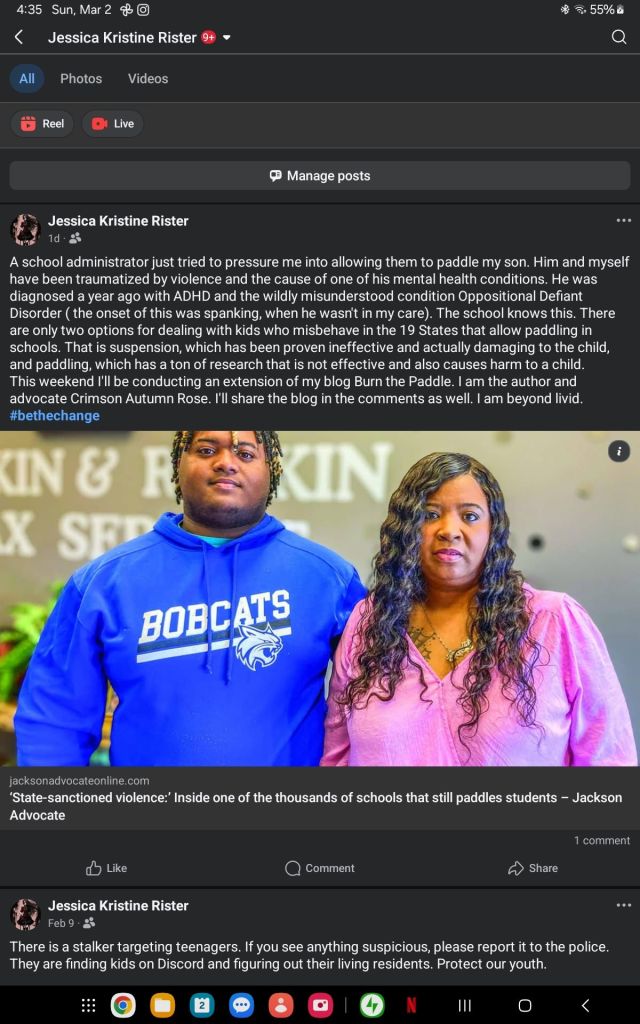
Last Friday a school administrator from my son’s school, whose name and location will remain anonymous, tried to pressure me into allowing him to switch (meaning paddling) him for misconduct. What I will say is that it was in one of the 19 states that still permitted paddling in schools. This school has tried pressuring me three times. Last Friday was the last draw.
When I moved here, I was appaled to recieve a sheet a paper in my “Register for School,” paperwork that asked for my permission to paddle my kids should they misbehave. This is not my parenting syle. I practice gentle parenting or empathy with boundaries. My children do not even get spanked, let alone hit with an object. Nor, would I allow another to strike my child, including other family members and/or caregivers. This includes school staff.
My son was traumaized by violence, which triggered a mental health conditon called Oppositional Defient Disorder. I was also traumatized by violence, which I eventually will publish my full story about. Needless, to say what we and many families who have similar histories do not need is more violence in our lives. Nor do we need pressure from others to punish our children in this manner. What we need is peace and healing.
I’m not saying to allow children to do what they want. They need to learn and grow to be productive adults. The problem is how the schools in these 19 States are haddling unfavorly behavior. There are only two options for this either send the kid home by suspending him or paddling. Who remembers more options, like writing sentences, when they went school?
In the article I shared across my social media platforms Friday, decribed a family that went through a similar situation as mine (1) . If you haven’t, please read through that. The school admitration pressured her to paddle her child as well. Even went so far as going against her wishes and doing it anyway. The article raises some really good points, like little girls wearing dresses, hitting too hard, and the harm it really causes a child from being struck by an adult they are supposed to trust.
After reading through the above mentioned article, I came across another article from the World Health Organizaton (WHO) (2). This article mentioned so may good points that I am going to add them here as they are.
Key facts
- Corporal or physical punishment is highly prevalent globally, both in homes and schools. Around 60% of children aged 2–14 years regularly suffer physical punishment by their parents or other caregivers. In some countries, almost all students report being physically punished by school staff. The risk of being physically punished is similar for boys and girls, and for children from wealthy and poor households.
- Evidence shows corporal punishment increases children’s behavioural problems over time and has no positive outcomes.
- All corporal punishment, however mild or light, carries an inbuilt risk of escalation. Studies suggest that parents who used corporal punishment are at heightened risk of perpetrating severe maltreatment.
- Corporal punishment is linked to a range of negative outcomes for children across countries and cultures, including physical and mental ill-health, impaired cognitive and socio-emotional development, poor educational outcomes, increased aggression and perpetration of violence.
- Corporal punishment is a violation of children’s rights to respect for physical integrity and human dignity, health, development, education and freedom from torture and other cruel, inhuman or degrading treatment or punishment.
- The elimination of violence against children is called for in several targets of the 2030 Agenda for Sustainable Development but most explicitly in Target 16.2: “end abuse, exploitation, trafficking and all forms of violence against and torture of children”.
- Corporal punishment and the associated harms are preventable through multisectoral and multifaceted approaches, including law reform, changing harmful norms around child rearing and punishment, parent and caregiver support, and school-based programming.
Consequences
Corporal punishment triggers harmful psychological and physiological responses. Children not only experience pain, sadness, fear, anger, shame and guilt, but feeling threatened also leads to physiological stress and the activation of neural pathways that support dealing with danger. Children who have been physically punished tend to exhibit high hormonal reactivity to stress, overloaded biological systems, including the nervous, cardiovascular and nutritional systems, and changes in brain structure and function.
Despite its widespread acceptability, spanking is also linked to atypical brain function like that of more severe abuse, thereby undermining the frequently cited argument that less severe forms of physical punishment are not harmful.
A large body of research shows links between corporal punishment and a wide range of negative outcomes, both immediate and long-term:
- direct physical harm, sometimes resulting in severe damage, long-term disability or death;
- mental ill-health, including behavioural and anxiety disorders, depression, hopelessness, low self-esteem, self-harm and suicide attempts, alcohol and drug dependency, hostility and emotional instability, which continue into adulthood;
- impaired cognitive and socio-emotional development, specifically emotion regulation and conflict solving skills;
- damage to education, including school dropout and lower academic and occupational success;
- poor moral internalization and increased antisocial behaviour;
- increased aggression in children;
- adult perpetration of violent, antisocial and criminal behaviour;
- indirect physical harm due to overloaded biological systems, including developing cancer, alcohol-related problems, migraine, cardiovascular disease, arthritis and obesity that continue into adulthood;
- increased acceptance and use of other forms of violence; and
- damaged family relationships.
There is some evidence of a dose–response relationship, with studies finding that the association with child aggression and lower achievement in mathematics and reading ability became stronger as the frequency of corporal punishment increased.
Risk factors
There are few differences in prevalence of corporal punishment by sex or age, although in some places boys and younger children are more at risk. Children with disabilities are more likely to be physically punished than those without disabilities. Parents who were physically punished as children are more likely to physically punish their own children.
In most of the countries with data, children from wealthier households are equally likely to experience violent discipline as those from poorer households. In contrast, in some resource-poor settings, especially where education systems have undergone rapid expansion, the strain on teachers resulting from the limited human and physical resources may lead to a greater use of corporal punishment in the classroom.
Prevention and response
The INSPIRE technical package presents several effective and promising interventions, including:
- Implementation and enforcement of laws to prohibit physical punishment. Such laws ensure children are equally protected under the law on assault as adults and serve an educational rather than punitive function, aiming to increase awareness, shift attitudes towards non-violent childrearing and clarify the responsibilities of parents in their caregiving role.
- Norms and values programmes to transform harmful social norms around child-rearing and child discipline.
- Parent and caregiver support through information and skill-building sessions to develop nurturing, non-violent parenting.
- Education and life skills interventions to build a positive school climate and violence-free environment, and strengthening relationships between students, teachers and administrators.
- Response and support services for early recognition and care of child victims and families to help reduce reoccurrence of violent discipline and lessen its consequences.
The earlier such interventions occur in children’s lives, the greater the benefits to the child (e.g., cognitive development, behavioural and social competence, educational attainment) and to society (e.g., reduced delinquency and crime).
Those were not my words, but it supports the point I am trying to get across. We need to stand up and fight for the welfare of our children. Stop making corporal punishment in schools and homes a part of their normal day to day and instead educate yourselves about what the children really need, a happy and healthy childhood they don’t need therapy to recover from.
Thank you for your time and energy. I wish those 19 States who haven’t banned paddling from schools the healing they desperatly need.
 Death & Roses